
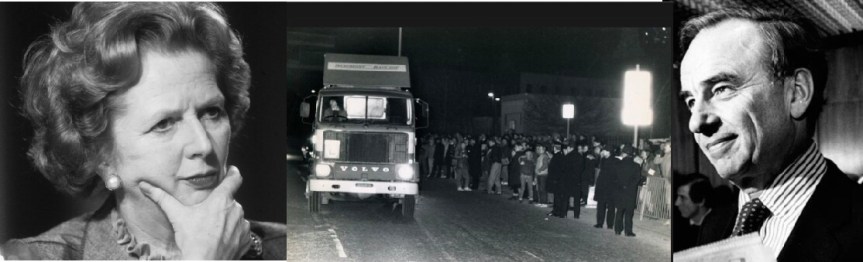
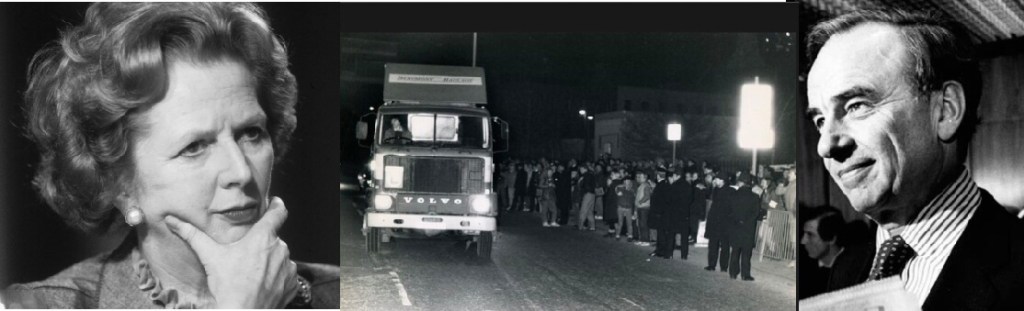
“You fuckwit! You bastard! Get this fucking newspaper out!”[1]. In 1986 on the first night of printing at the Sunday Times in their new facilities in Wapping, these were Rupert Murdoch’s dynamic words to his editor. Murdoch’s words seemed outrageous but circumstantially apropos. Murdoch had a master plan to move his newspapers out of Fleet Street by ousting the powerful press unions which would enable newspapers to embrace new technology in printing, increase production and cut expenditure.
Well before Rupert Murdoch was born, we go back in time to 1702 with the arrival of Britain’s first major newspaper to Fleet Street, the Daily Courant. The Daily Courant can be traced to a house that once stood on the eastern bank of the fetid River Fleet in London.[2] Fast forward the next two-hundred and eighty or so years, and National newspapers in Fleet Street included The Times, Daily Telegraph, Daily Express, The Sun, Daily Mail and Reuters. By the 1980’s Fleet Street was the major hub for British National newspapers.
Who was Rupert Murdoch and how did he manage to instigate the move of National newspapers out of Fleet Street? Murdoch was born Keith Rupert Murdoch on March 11, 1931, in Melbourne Australia. He gained his MBA from Oxford University in 1953 and spent a brief time as an editor at the London Daily Express. He returned to Adelaide in Australia in 1954, to take over the family business of the Adelaide Sunday Mail and The News. Murdoch is and was, a cunning and brilliant businessman. He is to this day , very involved in every aspect of his business’s.Over the years he changed the content of his papers to include gossip and sexy stories. Murdoch has a remarkable ability to combine the content of his publications to fit his own personal views, while successfully marketing them to the general public. After Adelaide, he later acquired newspapers in Brisbane, Melbourne, Perth, Sydney and went onto buy newspapers located all over the world.[3] In 1969 he started buying papers in the United Kingdom. He brought The News of the World in 1969, The Sun in 1974 [4]and The Times and The Sunday Times in 1981.
On the 4th May, 1979 Margaret Thatcher came to power as Britain’s Prime Minister. Murdoch gained Thatcher’s support with the incentive that both the Sunday Times and The Times, would share her right-winged policies.[5] His 1981 acquisition of The Times and The Sunday Times was astoundingly unchallenged and completed in just three days. The former editor of the Sunday Times, Harold Evans, wrote: “A newspaper merger unprecedented in history went through in three days.”. It was amazing how Margaret Thatcher’s government allowed such an acquisition to take place. Murdoch now had a monopoly, considerable power and government support.
Margaret Thatcher’s agenda included weakening the unions. She saw the unions as the “enemy within” and in a speech in 1984 Thatcher compared the unions to the external enemy of Britain’s enemy in war. “We had to fight the enemy without in the Falklands. We always have to be aware of the enemy within, which is much more difficult to fight and more dangerous to liberty.”[6] Both Thatcher and Murdoch wanted to make money and the unions were an obstruction to their goals.
The print unions, in the 1970’s and early 80’s were skilled male workers with immense power. They could shut down the manufacturing and profitability of the printing industry by simply stopping work. They were ‘closed shop’ (now illegal), which basically meant to join the company you had to be a member of the printing union. New technology implementation into production, had to be agreed by the unions or they would strike. Strikes stopped production and companies lost money.
New printing technology was the catalyst in the move out of Fleet Street in the 1980’s. The printing technology used in the 1970’s and early 1980’s was Linotype. It was invented in 1884 and was a “line casting” machine manufactured and sold by the former Mergenthaler Linotype Company[7]. The new technology for printing was phototypesetting and digital typesetting. This new printing technology required less manpower, increased productivity and was cheaper on labour costs. The significant reduction of manpower was a problem for the printing unions and they refused to accept the new technology. The unions simply had too much legal entitled power that enabled them to stop production and go on strike.
Murdoch’s plan was to move his newspapers out of London to his new Wapping facility but to do this he had to reduce the power of the print unions. The unions would grind productivity and profitably to a halt for their own self preservation by striking. The result of his plan would mean the ability to use the new print technology, have less staff because of the new technology, reduce costs, increase production and hire staff that could not strike. Ultimately, Rupert Murdoch would then gain back the control of production and his business. To initiate his plan he spread false rumours that News International (Murdoch’s parent company) was to produce The London Post newspaper in Wapping. It was genius, because at that time, if the print unions got hold of the truth they would strike and stop production without any legal retribution. Murdoch was helped by Thatcher and her new anti trade-union law. Under the new law, current employees who went on strike during negations, could be sacked on the spot and would lose their redundancy. Clandestinely, Murdoch began moving non-union staff into Wapping. He also hired new staff from the South Coast of England, mainly Bournemouth and they were not allowed to join the press unions, instead they had to join the Electrical, Electronic, Telecommunications and Plumbing Union (EETPU).[8] The EETPU had far less powers. This put the owners of printing companies back in the driving seat of their companies.
Thanks to Thatcher’s new anti trade-union law, Murdoch’s plan was falling into place nicely. In a short period of time, there was no longer any mention of the false rumours of the Sunday Post. The print unions quickly recognised a brewing storm and held talks with Murdoch’s legal advisors. The discussions to reach a mutually agreeable decision ended with no solidarity. On the 24th January 1986, almost six thousand newspaper workers went on strike. During the strikes it was obvious the government was working with Murdoch. Over one-thousand unionists were arrested when they picketed, yet Murdoch’s new workers and premises were protected by the police and didn’t lose one day of production.[9]
Murdoch had anticipated the unions striking and had taken legal advice. Without retribution, he immediately fired the striking men. Murdoch’s move to the ‘new brave new world’ [10]at Wapping took place on January 24th, 1986. Virtually overnight, more than 5,000 employees were abandoned.[11] People who worked within the unions who lost their jobs remain very bitter towards those who continued to work for Murdoch. “It was a war, and we lost it,” says Ron Garner, who worked in the Sun warehouse, in packaging and distribution. “We were led into a trap, and we played into his hands. I always say in my life there was a before and an after Wapping. It was a huge milestone, whatever way you look at it.”[12]
The failure of the strike was devastating for the print union workers, and it led both to a general decline in trade unions influence in the UK, and to a widespread adoption of modern newspaper publishing practices. [13] Before Wapping, the British newspaper industry was in trouble. Journalists were banned from using new technology, the print unions had too much power, they had high labour costs, slow productively, restrictive practices, endless strikes and industrial disruption. Wapping provided the platform for technological development within the publishing industry.[14]
In my opinion, Rupert Murdoch may be an unpopular hard minded businessman but he must be credited for masterminding the 1980’s move of British National newspapers away from Fleet Street to Wapping. He potentially saved the British newspaper Industry and allowed it to grow with technology by taking the power away from the unions. Murdoch organised the ultimate demise of the printing unions, created a more cost effective, less manpowered platform and embraced new printing technology. In the fullness of time, with his move to Wapping, Rupert Murdoch changed the British newspaper industry. Murdoch later said of the print unions “they had a noose round the neck of the industry, and they pulled it very tight.”[15].
[1] Chenoweth, Alan.Virtual Murdoch. London: Secker & Warburg, 2001.
[2] Green,Matthew,’The fascinating history of Fleet Street’,The Telegraph online.London.21 May 2018, 3:45 pm.
[3] The Editors of Encyclopaedia Britannica (1998) Rupert Murdoch | Biography & Facts.
Available at: https://www.britannica.com/biography/Rupert-Murdoch.
[4] Wikipedia contributors (2023) Rupert Murdoch. Available at: https://en.wikipedia.org/wiki/Rupert_Murdoch.
[5] Curran, J. and Seaton, J. (2018) Power Without Responsibility Press, Broadcasting and the Internet in Britain. Oxen, Abingdon, United Kingdom of Great Britain and Northern Ireland: Routledge.p119.
[6] Margaret Thatcher speech to the backbench 1922 committee, July 1984.
[7] “End of story for Linotype”. Deseret News. (Salt Lake City, Utah). UPI. November 26, 1970. p. 20B.
[8] Wikipedia contributors (2022c) Wapping dispute.
Available at: https://en.wikipedia.org/wiki/Wapping_dispute.
[9] Travis, A. (2017) National archives: Margaret Thatcher wanted to crush power of trade unions. Available at: https://www.theguardian.com/uk-news/2013/aug/01/margaret-thatcher-trade-union-reform-national-archives.
[10] Pilger, J. (1998) Hidden Agendas. Random House.
[11] Rupert Murdoch’s Dirtiest Deed the Wapping Dispute 1986 (2018). Available at: https://metaltype.co.uk/wpress/fortress-wapping/.
[12] Henley, J. (2017b) Rupert Murdoch and the battle of Wapping: 25 years on. Available at: https://www.theguardian.com/media/2011/jul/27/rupert-murdoch-wapping-25-years.
[13]Wikipedia contributors (2022) Wapping dispute. Available at: https://en.wikipedia.org/wiki/Wapping_dispute.
[14] Neil, A. (2017) Wapping: legacy of Rupert’s revolution. Available at: https://www.theguardian.com/business/2006/jan/15/rupertmurdoch.pressandpublishing.
[15] Furdyk, B. (2022) The Untold Truth Of Rupert Murdoch. Available at: https://www.nickiswift.com/672589/the-untold-truth-of-rupert-murdoch/.
 Soozi’s Grown Up Life