

Great News, recycling rates in the UK have increased since they began in the 1980s. Now for The bad news, recycling rates have slowly reduced within the last 10 years. Household recycling in the United Kingdom has evolved into a crucial aspect of waste management, spurred by environmental consciousness and the pursuit of sustainability; advancements in household recycling, including developing infrastructure and attaining heightened awareness. I will explore the historical journey of household recycling in the UK, examine the recycling targets set by our Government, discover the current progress in achieving these targets through education and behavioural studies and reiterate the importance of recycling to preserve our planet.
Recycling dates back to 1031 in Japan, with paper recycling initiated by the Japanese because of the lack of resources such as materials, paper, and proficient workers; the proprietors of private estates initiated the establishment of compact paper mills. The wastepaper became a valuable material for remaking into sheets of paper.
The UK began general rubbish pick up with the metal dustbin standardised in the 1960s by local councils. Early Development of recycling in the UK gained traction during the 1970s as the public became increasingly aware of the environmental impact of waste. Individuals, environmental organisations, and government bodies were vital in promoting recycling. The concept of recycling bins provided by local councils emerged in the 1980s, enabling households to separate recyclable materials from general waste.
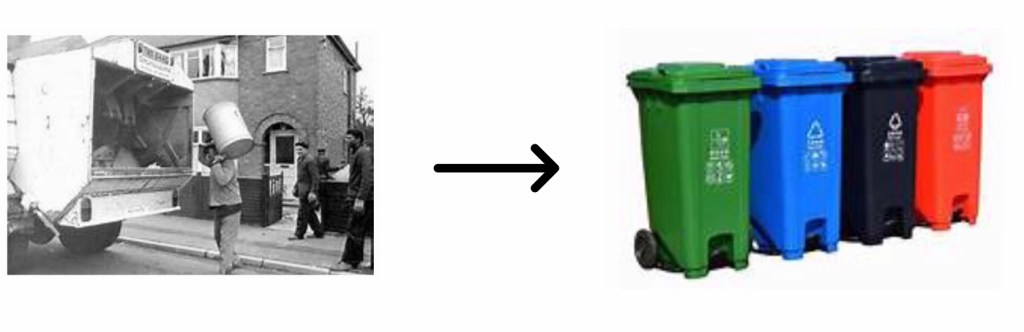
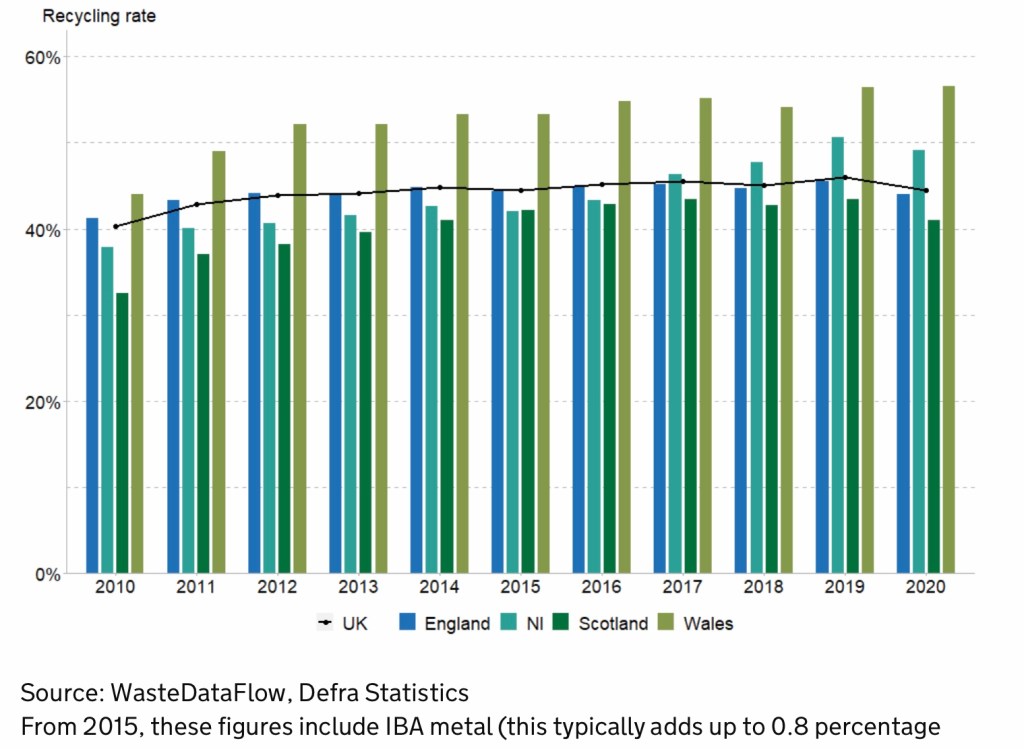
In the early years, the recycling rates in the UK were modest, primarily due to limited infrastructure and public awareness. However, concerted efforts by local authorities, environmental campaigns, and government support led to substantial advancements. Recycling rates gradually increased as communities embraced recycling practices and local councils expanded their recycling programs with efficient collection systems, sorting facilities, and partnerships with recycling plants to process and reuse recyclable materials. Today, however, according to Defra and Statista in an article by Bruno Alves, those recycling rates have gradually begun to decrease. “The recycling rate from household waste in the United Kingdom was 44.4 per cent in 2020 – a decrease from 46 per cent in 2019. Wales has consistently had the highest recycling rate for household waste in the UK, and in 2020 it reached a high of 56.5 per cent. Scotland had the lowest recycling rate that year, at 41 per cent.”
Once collected, household recyclable materials undergo sorting processes to separate different types of materials. They are then prepared for reuse or sent to recycling plants. While a significant portion of recycling stays within the UK, much is exported to countries with advanced recycling infrastructure for processing—however, concerns regarding the environmental impact of exporting recycling and the need for greater domestic recycling capabilities. Roughly two-thirds of plastic waste in the UK goes overseas to be recycled partly to reduce costs. BBC analysis suggests the UK exported 611,000 tonnes of plastic packaging to other countries in the year to October 2018.
After Brexit, the UK government assumed responsibility for environmental policy, taking over from the EU. They have a comprehensive Resource and Waste Strategy to establish a circular economy in England. The 2018 Resource and Waste Strategy for England sets a challenging recycling goal of 65% for municipal waste to be reached by 2035. The UK recycling rate fluctuates between 45% and 47% and has consistently failed to meet the 65% target set by the post-Brexit Resource and Waste Strategy. We are almost 20% behind our target, with 12 years to reach that goal.
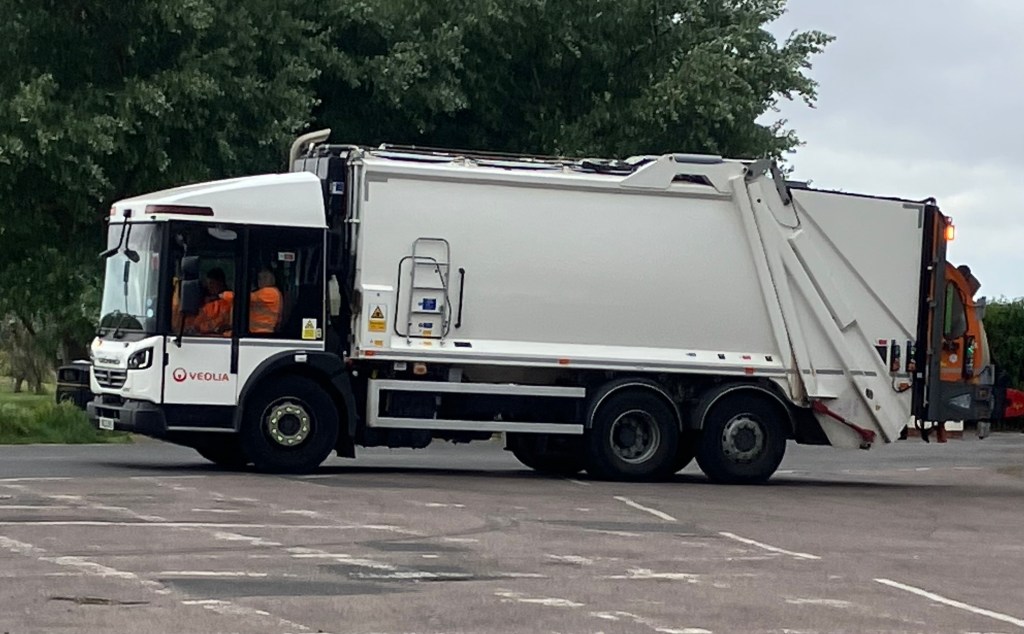
For the future of recycling, we need to change human attitudes and behaviour. Adults over 30 grew up with no fundamental understanding of recycling and how it can help the environment. I fit into the category of being well over thirty years old and grew up with no recycling methods. In my day, “everything” went into the tin can bin; we were a throwaway society. My recycling man said to me this morning, “Love, you can take a photo of my big truck for a recycling article, but your recycling is crap”.
The need for behavioural change to recycling is supported by evidence from expert waste management studies conducted from 2013 until 2020. These studies emphasise the need to understand the behaviours of consumers to implement effective interventions and tailor recycling services accordingly, thus enabling a successful recycling system. The evidence mentioned in one study in 2020 entitled “Moving from Directives toward Audience Empowerment, A Typology of Recycling Communication Strategies of Local Governments” references; direct engagement between local authorities and communities is essential for successful recycling programs in the UK. Conducting site tours of recycling facilities for residents helps dispel misconceptions, promotes source segregation, and increases participation. Additionally, organising awareness programs and maintaining effective communication channels with the public can significantly improve the recycling rate.
Despite these expert studies, UK local councils responsible for recycling mainly focus on communication campaigns rather than the behaviour of their recycling constituents. It is crucial to prioritise all demographics and educate and understand all consumer groups to increase recycling.
A few things for us all to consider before you throw away anything include: recycling a single aluminium can will power a TV for 3 hours or an iPod for 20 hours; recycling everything in your kitchen bin for one month could power a TV for six months; one glass bottle recycled saves energy to power a laptop for 30 minutes; a plastic bottle recycled saves energy to power a lightbulb for 3 hours; UK households produce 7 million tonnes of food waste yearly, worth £7.5 billion and 50% is still edible; 2 million discarded TVs are in UK landfills, and as much as 80% of the things we throw away could be recycled.
The American actor Ed Begley Jr. was deeply influenced by the inaugural Earth Day in 1970, prompting him to become an environmental activist and make significant changes to his way of life.
“If you’re not buying recycled products, you’re not really recycling.”
Recycling in the UK has witnessed significant progress over the years from the 1980s; however, it needs to improve further to reach the new recycling targets of 65% set by the UK government for 2035. Recycling is vital for the planet because it protects our natural resources and reduces environmental degradation; saves energy; reduces emissions, waste and landfill; and protects our habitats so we are not continually taking products from the earth. Changing and working with human behavioural studies is one angle that may achieve overcoming one of the most prominent problems societies and governments face in reaching safe levels of recycling, reducing our toxic human footprint and safeguarding the planet for future generations.
Sources:
Yukalang, N., Clarke, B., & Ross, K. (2017). Barriers to Effective Municipal Solid Waste Management in a Rapidly Urbanizing Area in Thailand. International Journal of Environmental Research and Public Health, 14(9), 1013. https://doi.org/10.3390/ijerph14091013
Timlett, R., & Williams, I. H. (2011). The ISB model (infrastructure, service, behaviour): A tool for waste practitioners. Waste Management, 31(6), 1381–1392. https://doi.org/10.1016/j.wasman.2010.12.010
Lee, D., & Krieger, J. L. (2020). Moving from Directives toward Audience Empowerment: A Typology of Recycling Communication Strategies of Local Governments. Sustainability, 12(7), 2722. https://doi.org/10.3390/su12072722
 Soozi’s Grown Up Life